
- All
- Product Name
- Product Keyword
- Product Model
- Product Summary
- Product Description
- Multi Field Search
Views: 0 Author: Site Editor Publish Time: 07-22-2026 Origin: Site


In high-altitude and alpine environments, outdoor gear must solve two opposing challenges simultaneously. Severe ultraviolet radiation and extreme thermal loss constantly threaten the wearer. Garments must block intense solar rays while retaining vital body heat. Selecting the right outer shell material requires balancing tight weaves for insulation retention against specialized treatments for solar defense. You cannot simply rely on basic material specifications. Doing so often leads to compromised gear. It either degrades rapidly under intense UV exposure or suffers from frustrating insulation leakage over time.
This guide breaks down the technical evaluation criteria for sourcing high-performance textiles. We will explore the complex mechanics of down-compatible weaves and advanced sun-blocking treatments. By following these rigorous evaluation frameworks, you can confidently select materials for extreme conditions. You will ensure your final product meets stringent durability, safety, and performance standards.
Standardized Testing is Non-Negotiable: True UPF claims require verified testing (e.g., AATCC 183) to account for wetness, stretch, and lifecycle degradation.
Density Serves Dual Purposes: High-density weaves required for downproof nylon fabric naturally elevate baseline UV resistance, though chemical treatments are needed for extreme environments.
Beware the Breathability Trade-off: Heavily calendered (cired) fabrics prevent down leakage and block UV rays but drastically reduce moisture vapor transmission rates (MVTR).
UPF 100+ is for Extreme Use Cases: Specifying UPF 100+ fabric is generally reserved for prolonged high-altitude exposure where standard UPF 50+ offers insufficient long-term degradation margins.
Alpine gear faces uniquely hostile atmospheric conditions. Ultraviolet radiation intensity increases by roughly 10-12% for every 1,000 meters of elevation gained. Mountaineers operating above 4,000 meters experience vastly amplified UV exposure. Snow and ice surfaces further compound this danger. High albedo effects reflect up to 80% of UV rays back onto the wearer. Gear must handle this severe radiation while enduring sub-zero temperatures.
This environment creates a severe material conflict. Shell fabrics must remain exceptionally lightweight for active pursuits. They must also feature a tight enough weave to contain fine down clusters. Furthermore, manufacturers must chemically or structurally treat these textiles to block UVA and UVB rays. They must achieve this without compromising the fabric's soft hand-feel or baseline tear strength. Heavy coatings ruin the supple drape needed for insulated jackets. Thin, untreated nylons fail to protect the user or the insulation.
Failing to specify the correct dual-purpose fabric introduces severe risks. Premature UV degradation weakens the nylon shell rapidly. Weakened fibers easily succumb to abrasion against rocks or ice. This degradation eventually causes micro-tears across the garment surface. Once the structural integrity fails, you experience catastrophic insulation loss. Small feathers and valuable down clusters escape through the weakened matrix. You ultimately end up with a deflated, non-functional alpine jacket.
Common Mistakes in Alpine Sourcing:
Prioritizing denier weight exclusively while ignoring thread count density.
Assuming all winter gear inherently blocks UV radiation due to its thickness.
Neglecting the snow-glare reflection effect during baseline material testing.
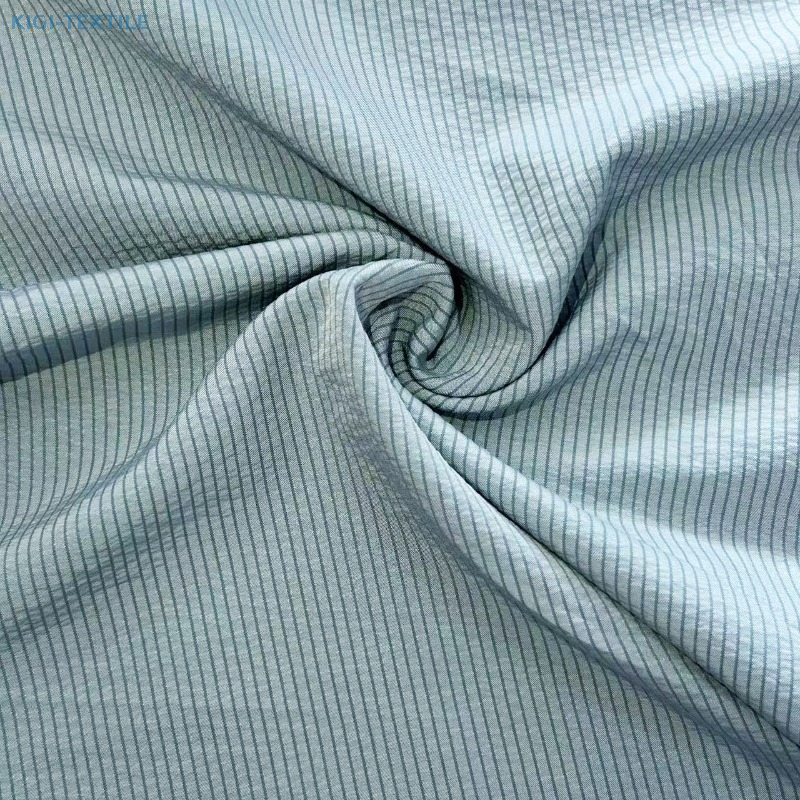
You must rigorously evaluate how UV protection fabrics achieve their sun-blocking capabilities. The industry generally utilizes two distinct defense mechanisms. Structural UV defense relies on inherent yarn properties. Manufacturers embed titanium dioxide (TiO2) particles directly into the synthetic polymers before spinning the yarn. This method creates a permanent shield. It scatters UV rays effectively and never washes out. Chemical UV defense involves topical treatments applied during the dyeing or finishing stage. These chemical absorbers break down over time. They inevitably degrade after repeated laundering and field abrasion.
Decision-makers often debate the reality and necessity of extreme UPF ratings. A standard UPF 50 rating blocks 98% of incoming UV rays. A specialized UPF 100+ fabric blocks over 99%. The 1% difference might seem mathematically insignificant. However, the primary business value of UPF 100+ lies in its degradation margin. Extreme conditions degrade fabrics rapidly. A garment starting at UPF 100+ ensures it maintains at least a highly functional UPF 50 rating after months of heavy wear, harsh washing, and mechanical stretching.
Standardized testing remains absolutely critical for verifying these claims. Require your suppliers to provide exhaustive documentation. You should demand lab results based on globally recognized standards. Look for AATCC 183 in the US market. Seek EN 13758-1 for European compliance. Use AS/NZS 4399 for Australasian standards. These protocols measure precise UV transmittance through the textile matrix.
You must also carefully evaluate hidden lifecycle risks. Fabric UPF naturally decreases when the material becomes wet, stretched, or abraded. A tight weave opens up when placed under mechanical tension. Water molecules reduce the scattering effect of the fibers. Decision-makers must evaluate UPF ratings based on the expected end-of-life performance. Never base extreme alpine gear decisions solely on pristine showroom condition metrics.
Understanding the intricate role of denier and weave density solves half the sourcing puzzle. High-end alpine gear typically utilizes micro-ripstop nylons. These yarns range from 10D to 30D for lightweight applications. Denier measures the thickness of the individual yarn. Lower denier means lighter weight. However, preventing feather poke-through requires massive thread counts. You need thread counts exceeding 300T (threads per square inch). This high density acts as the structural foundation for preventing insulation leakage.
When sourcing downproof nylon fabric, you must choose between calendering and coating techniques. Calendering applies intense heat and pressure to the woven textile. Heated heavy rollers compress the nylon fibers. The fibers melt slightly and fuse together, sealing the microscopic gaps between yarns. This process remains the industry standard. It achieves high downproof ratings while retaining fabric suppleness. Coating involves applying a layer of polyurethane (PU) or silicone. This adds significant weather resistance. Unfortunately, it also adds bulk weight and heavily restricts crucial breathability.
Evaluation Metric | Heat Calendering (Cire) | PU/Silicone Coating |
|---|---|---|
Down Retention | Excellent (Seals fiber gaps mechanically) | Excellent (Creates a physical barrier) |
Fabric Suppleness | Maintains soft drape and hand-feel | Often feels stiff or crinkly |
Breathability (MVTR) | Moderate to High | Low to Very Low |
Weight Impact | Negligible | Noticeable increase |
You must establish strict evaluation criteria for downproofness. Do not accept casual assurances from fabric mills. Demand documented rotating box tests from your suppliers. The EN 12132-1 standard provides excellent scientific verification. This test places a sewn fabric pillow filled with down inside a rotating cubic box. Silicone stoppers pummel the pillow for hours. Technicians then meticulously count every escaped feather. This simulates a rigorous physical lifecycle and proves the fabric's retention capability.
Creating elite outdoor gear requires finding the perfect intersection between sun protection and insulation retention. Synergies in textile construction naturally assist this goal. The same tight weave required to contain micro-feathers minimizes the physical gaps between threads. Furthermore, the intense heat-calendering process flattens the yarns. This mechanical flattening drastically reduces the interstitial spaces where UV light typically passes through. Therefore, a highly engineered down-retaining nylon naturally establishes a robust baseline of sun protection.
However, implementation trade-offs plague the engineering process. You face a severe conflict between breathability and protection. Maximizing UV shielding and feather-retention inherently seals the fabric. This heavily sealed matrix drastically lowers the Moisture Vapor Transmission Rate (MVTR). Active users generate massive amounts of sweat during alpine ascents. If the shell traps this moisture, the down insulation wets out and loses its thermal properties. You must evaluate if the jacket requires mechanical venting. Adding pit zips or engineered baffles helps compensate for the lost fabric breathability.
Durable Water Repellent (DWR) interactions present another complex challenge. Manufacturers apply DWR to force water to bead up and roll off the garment. However, topical UV-blocking treatments and DWR coatings sometimes fight for adhesion space on the nylon substrate. The chemical bonding agents can interfere with one another. This interference often results in patchy water resistance or degraded sun protection after minimal washing.
Best Practices for Supply Chain Consolidation:
Source pre-treated, pre-calendered fabrics directly from a single tier-1 mill.
Avoid purchasing raw nylons and applying aftermarket chemical UV treatments at a secondary facility.
Request simultaneous testing for UV transmittance and hydrostatic head resistance on the exact same fabric batch.
Selecting the right manufacturing partner mitigates enormous downstream risks. You must interrogate potential suppliers systematically. Vague answers regarding testing methodologies signal a lack of technical capability. Use a structured framework to qualify or disqualify fabric mills early in the sourcing phase.
Ask these critical questions during supplier negotiations:
What is the guaranteed UPF rating after 40 standard wash cycles? Demand to see the degradation curve, not just the pre-wash peak performance.
Can you provide recent third-party lab results for both UV transmittance (AATCC 183) and down penetration testing (EN 12132-1)? Internal lab tests lack independent verification.
Does the textile utilize PFAS-free DWR alongside its integrated UV treatments? You must ensure compliance with incoming chemical regulations in California and the European Union.
Prototyping recommendations save companies thousands of dollars in ruined production runs. Always order ample sample yardage for rigorous baffle construction tests. A pristine flat sheet of nylon may test perfectly in the laboratory. However, sewing machines aggressively puncture the textile matrix during production. Needles sever yarns and create micro-holes. The fabric might leak down clusters heavily at these needle puncture sites once sewn. You must test the fully sewn prototype before committing to massive production minimums.
Choosing the right shell material for high-altitude gear requires careful navigation of competing engineering demands. The ideal textile heavily relies on inherent fiber density and precision heat-calendering to achieve supreme downproofness. You should supplement this structural foundation with embedded UV-blocking particulates. This combined approach ensures permanent, long-term solar defense without sacrificing fabric suppleness.
Prioritize manufacturing partners offering certified, independent testing for both AATCC 183 and EN 12132-1 standards. Always request detailed technical data sheets (TDS) during the initial sourcing phase. Finally, order sufficient sample yardage for physical needle-puncture and baffle testing. Prototyping verifies real-world performance before you authorize expensive commercial production runs.
A: Not necessarily. While the tight weave helps, lightweight nylons (10D-15D) can still transmit significant UV radiation if they are light-colored and lack specific UV-blocking additives. You must test the specific dye lot and finish to verify its actual sun-blocking capabilities.
A: For general urban or low-elevation winter wear, standard UPF 50+ is more than sufficient. UPF 100+ is specifically evaluated for high-altitude mountaineering, glacier travel, or polar expeditions where snow glare and thin atmosphere exponentially increase UV load.
A: Chemically treated fabrics will slowly lose their UPF rating over 30-50 washes. Fabrics utilizing structural tight weaves and embedded Titanium Dioxide (TiO2) yarns maintain their protection for the life of the garment, provided the fabric does not become thin or overly stretched.
A: Use a high-quality ballpoint or microtex needle to part the threads rather than cutting them. Utilize a stitch length of 10-12 stitches per inch. You should also consider seam-taping or using internal baffle walls to secure the down clusters effectively.


