


BS 5852 Explained: Ignition Sources, Crib 5 Testing and Upholstery Fabric Requirements
BS 5852 is one of the most frequently specified British fire-test standards for upholstered seating. Buyers may see terms such as “BS 5852,” “Source 0,” “Source 1,” “Ignition Source 5” or “Crib 5” in furniture, upholstery and contract-project specifications.
These terms do not describe the same level of ignition challenge. They also do not mean that a fabric automatically complies when it is combined with any foam, interliner or other filling material.
This guide explains what BS 5852 evaluates, how its commonly requested ignition sources differ, what buyers should look for in a test report and why the complete upholstery construction matters.
What Is BS 5852?
BS 5852:2006 is titled Methods of test for assessment of the ignitability of upholstered seating by smouldering and flaming ignition sources.
The standard provides methods for evaluating the ignitability of material combinations used in upholstered seating, including cover fabrics, interliners and filling materials. It may also be used to assess complete items of upholstered seating.
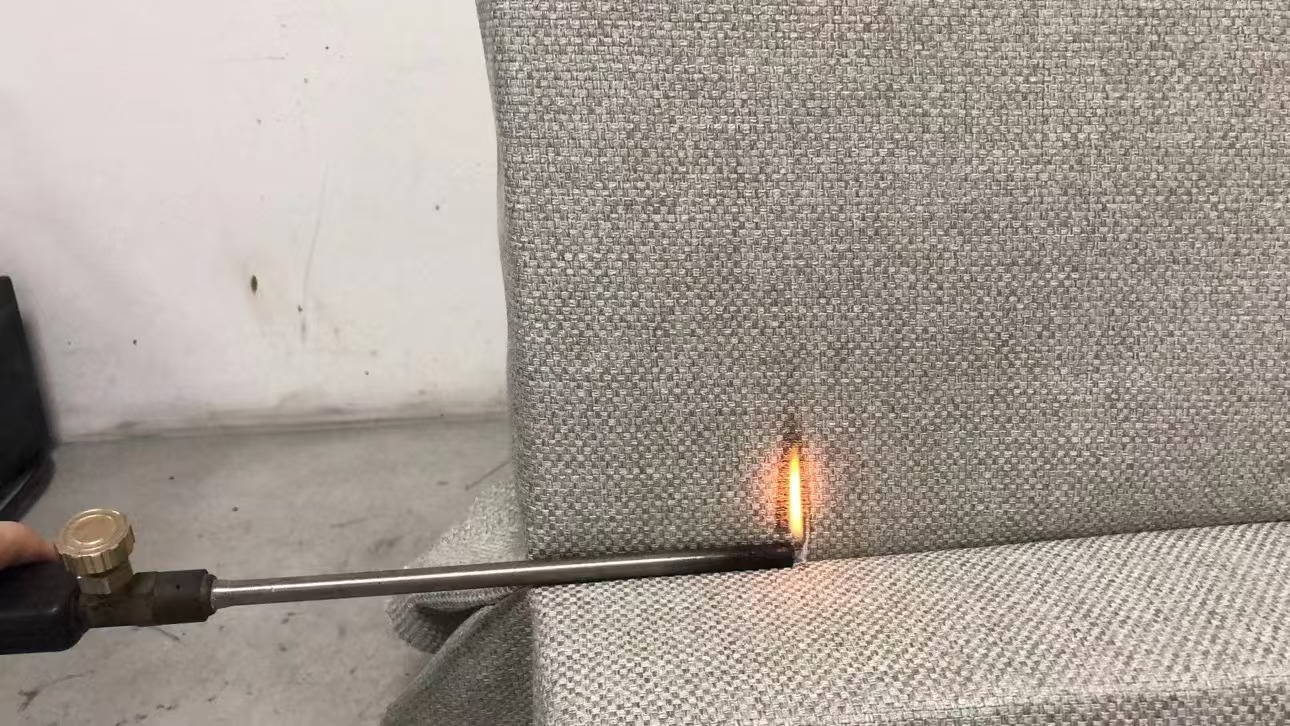
During a composite test, the cover and filling materials are arranged on a test rig that represents the junction between the seat and back of an upholstered chair. A specified smouldering or flaming ignition source is then applied at the junction.
What Products Does BS 5852 Cover?
BS 5852 is primarily relevant to upholstered seating and its material combinations. Potential applications include:
Sofas and upholstered chairs
Hotel and hospitality seating
Restaurant, bar and nightclub seating
Office and reception seating
Cinema and theatre seating
Care-home and healthcare seating
Educational and public-space seating
Replaceable and loose upholstery covers
BS 5852 is not normally the correct standard for curtains, tents, bags, protective garments or bedding. These products may require different fire-test standards according to their final use and destination market.
BS 5852 Ignition Sources Explained
BS 5852 uses ignition sources of different types and intensities. The most frequently requested levels in commercial specifications are Source 0, Source 1 and Source 5.
| Ignition Source | Common Name | Type of Ignition | Relative Challenge | Common Context |
|---|---|---|---|---|
| Source 0 | Cigarette Test | Smouldering cigarette | Lower | Smouldering ignition risk |
| Source 1 | Match-Flame Test | Small butane flame | Higher than Source 0 | Small open-flame risk |
| Source 5 | Crib 5 Test | Flaming wooden crib | Substantially higher | Contract and higher-risk seating specifications |
A pass against one ignition source should not be reported as a pass against every BS 5852 ignition source. The exact source number must appear in the product specification and test report.
Ignition Source 0: Smouldering Cigarette
Source 0 uses a smouldering cigarette to assess whether the upholstery combination exhibits progressive smouldering or flaming ignition.
The cigarette is placed at the junction between the horizontal and vertical parts of the test specimen. The laboratory monitors the cover and filling materials for continued smouldering, flame development and other failure criteria specified by the standard.
Ignition Source 1: Match-Flame Equivalent
Source 1 uses a small butane flame intended to represent a small open-flame ignition source, commonly described as a match-flame equivalent.
It presents a more severe flaming challenge than a smouldering cigarette. The laboratory observes whether flaming or progressive smouldering continues after the burner is removed.
Ignition Source 5: Crib 5
Ignition Source 5 is widely known as the Crib 5 test. It uses a specified wooden crib that produces a more severe flaming ignition challenge than Source 0 or Source 1.
The crib is positioned on the upholstery composite at the seat-and-back junction and ignited under controlled laboratory conditions. The test monitors flaming, progressive smouldering, damage and whether the upholstery combination meets the applicable non-ignition criteria.
Crib 5 is frequently specified for contract furniture used in hotels, restaurants, bars, entertainment premises and other public or commercial environments. However, the required level must be established by the applicable specification, fire-risk assessment and local regulatory requirements.
BS 5852 vs BS 7176: What Is the Difference?
BS 5852 principally describes test methods for assessing the ignitability of upholstered seating materials and complete seating.
BS 7176 specifies resistance-to-ignition requirements for non-domestic upholstered seating by using appropriate test methods, including BS 5852 and BS EN 1021, according to the intended end-use environment.
| Standard | Primary Purpose | Typical Use |
|---|---|---|
| BS 5852 | Provides ignitability test methods | Testing upholstery composites or complete seating |
| BS 7176 | Specifies ignition-resistance requirements for non-domestic seating | Selecting requirements according to the non-domestic environment |
Why the Complete Upholstery Composite Matters
A common purchasing mistake is assuming that a test result belongs only to the visible cover fabric. BS 5852 commonly evaluates the behavior of an upholstery combination.
The result may be affected by:
Cover-fabric composition and weight
Weave or knitted construction
Flame-retardant treatment
Backing or coating
Interliner type
Foam composition and density
Other filling materials
Seams and construction details
Pre-treatment, cleaning or water-soaking conditions
A cover fabric that passes when tested over one specified foam may perform differently over another foam. Therefore, the test report must identify the complete material combination and test conditions.
What Does a BS 5852 Pass Result Mean?
A pass result indicates that the tested specimen met the applicable non-ignition criteria for the specified ignition source under the laboratory conditions stated in the report.
A technically complete claim should identify:
The standard and edition
The ignition source used
The tested cover fabric
The foam, filling and interliner
Any FR treatment, coating or backing
Pre-treatment and conditioning
The testing laboratory
Report number and issue date
Tested to BS 5852:2006, Ignition Source 5, as an upholstery composite using the cover fabric and filling materials identified in the test report.
“BS 5852 certified fabric,” “completely fireproof” or “suitable for all furniture” without identifying the ignition source and tested composite.
How to Specify BS 5852 Upholstery Fabric
Buyers should provide the following information when requesting a sample or quotation:
Final furniture application
Domestic or non-domestic environment
Destination country or market
Required ignition source: 0, 1, 5 or another level
Applicable product or project specification
Cover-fabric composition and weight
Required color and finish
Foam, interliner and filling materials
Cleaning and durability requirements
Required laboratory and documentation
When possible, the production materials should match the tested construction. Changing the foam, backing, coating, interliner or FR treatment may affect the relevance of the original report.
Common BS 5852 Purchasing Mistakes
1. Not Stating the Ignition Source
“BS 5852 required” is incomplete. Source 0, Source 1 and Source 5 represent different ignition challenges.
2. Treating a Composite Result as a Universal Fabric Result
A result obtained using one cover-and-filling combination may not apply to every foam, backing or furniture construction.
3. Using BS 5852 for the Wrong Product
Curtains, bedding, tents, protective clothing and building products may require different standards. The test method must match the final application.
4. Ignoring FR Treatment Durability
Cleaning, washing, abrasion and aging can influence treated material performance. Buyers should specify any required pre-treatment or durability condition before testing.
5. Accepting an Incomplete Test Report
A report should identify the tested specimen, ignition source, material combination, conditioning, observations and final result. A product photo or general marketing statement is not a substitute for a complete report.
Frequently Asked Questions
Is BS 5852 the Same as Crib 5?
No. BS 5852 contains multiple smouldering and flaming ignition sources. Crib 5 specifically refers to Ignition Source 5 within the BS 5852 test framework.
What Is the Difference Between Source 0 and Source 1?
Source 0 uses a smouldering cigarette. Source 1 uses a small butane flame representing a small open-flame or match-type ignition source.
Is Crib 5 More Severe Than the Match Test?
Yes. Ignition Source 5 uses a flaming wooden crib and represents a substantially greater ignition challenge than Source 1.
Can a Fabric Alone Pass BS 5852?
A laboratory may test a cover fabric with specified supporting materials, but the result relates to the tested construction. It should not automatically be extended to every foam, filling or finished item.
Does a Crib 5 Pass Mean the Furniture Is Fireproof?
No. It means the tested upholstery combination met the applicable criteria under the specified test conditions. It does not mean that the furniture cannot burn under every fire scenario.
Is BS 5852 Suitable for Curtains or Tents?
BS 5852 is principally an upholstered-seating test. Curtains, tents and other textile products normally require standards selected specifically for those applications and markets.
Conclusion
BS 5852 provides a structured method for evaluating how upholstered seating materials respond to smouldering and flaming ignition sources.
Source 0 represents a smouldering cigarette, Source 1 represents a small open flame and Source 5 uses a more severe flaming wooden crib. A complete specification must identify the exact ignition source rather than simply stating “BS 5852.”
Most importantly, buyers should evaluate the complete upholstery composite. Cover fabric, foam, interliner, backing, coating and construction details can all influence the result.
Need a Flame-Retardant Fabric Solution?
Contact KIGI TEXTILE to discuss flame-retardant woven fabrics, coating options and test requirements. Please include the final application, destination market, required standard, ignition source and complete material specification. Request a Sample or Quotation


